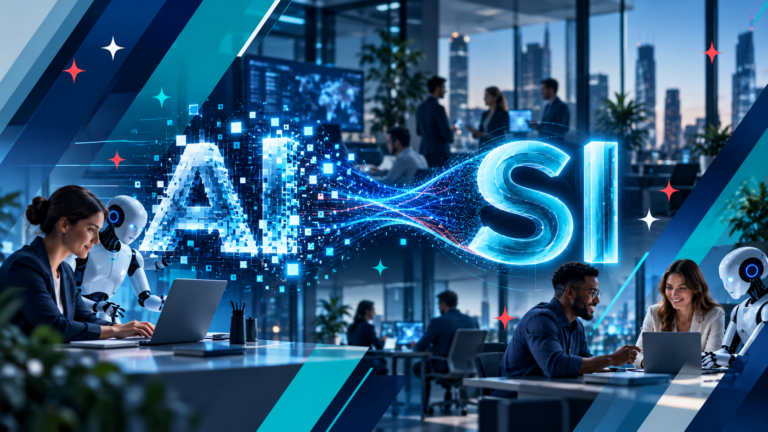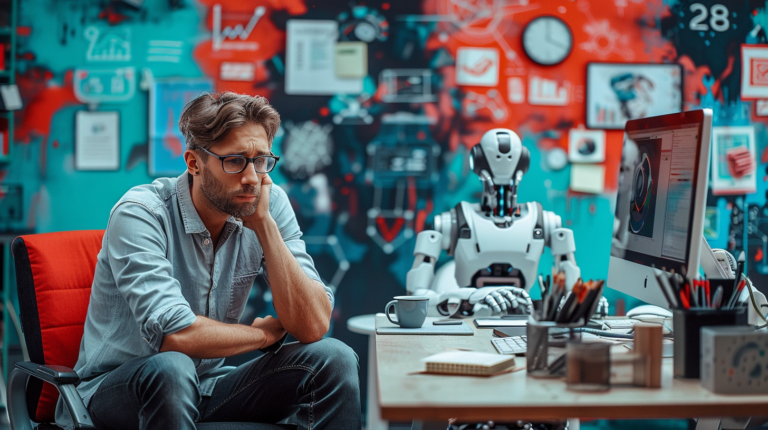
In October 2025, Accenture announced it’s slashing 11,000 jobs as AI rapidly transforms every industry. Across every sector, AI is rewriting the rules of work. Headlines scream about job losses, panic fills LinkedIn feeds, and people are left wondering: Is my role next? Am I at risk of becoming redundant and losing my job or employability in my field?
But maybe we’re looking at it the wrong way. What if this massive shift isn’t the end of human work but the start of something better?
This blog discusses how AI’s rise, while intimidating, might actually be a good thing – pushing us to evolve, focus on creativity and relationships, and rediscover what makes human work truly valuable, even in the AI era.
AI Revolution: Evolution Always Starts with Disruption
Every major technological leap in history began with fear. When machines took over factories, people thought manufacturing jobs were gone forever – yet we built entire new industries around them. When the Internet came, we worried it would destroy traditional business, but instead, it created millions of new ones. AI is just the next chapter of that same story – though faster and infinitely more transformative.
The truth is that AI is reshaping work. It’s stripping away the repetitive, manual, time-consuming tasks that used to fill our days. Writing reports, analyzing spreadsheets, coding simple features, scheduling meetings – all now done in seconds. What’s left are the creative, strategic, and human parts of the job – but even creativity is being redefined. AI can now write, design, and compose, giving everyone access to creative capabilities once reserved for specialists. The difference is that humans now guide the process – deciding what to create, why, and how it should feel. We prompt the ideas, shape the direction, and add the human touch that turns output into meaning.
Disruption feels scary because it exposes how quickly the world moves without our permission. But history shows that every wave of automation has led to new opportunities for those willing to adapt. The winners of the AI era will be those who learn to ride the change.
Why AI Might Actually Be a Good Thing
AI is forcing people to upskill and evolve
AI is pushing everyone – from marketers to software developers – to learn new tools, adapt faster, and think more creatively. It’s uncomfortable at first, but that’s how evolution works. This new wave of technology challenges us to sharpen our human edge – creativity, critical thinking, and emotional intelligence. Without this push, many would have stayed stuck doing repetitive, low-value work that machines now gladly handle.
AI is killing boring, repetitive tasks
AI takes over the brain-numbing parts of work – data entry, reports, scheduling – freeing people to do what humans do best: think, create, and solve complex problems. And let’s be honest, those were the tasks no one wanted to do anyway. By removing the noise, AI lets people focus on work that’s actually fulfilling.
AI is creating new jobs we never had before
Every major innovation in history created new roles, and AI is no different. We now have AI Trainers, AI Full-Stack Developers, Ethics Experts, Automation Strategists – jobs that didn’t exist five years ago. Some old roles will disappear, but many more will emerge – often more creative and better paid. To be precise, 92 million jobs are expected to be displaced, and 170 million new roles will be created.The opportunity lies in learning how to work with AI, not against it.
AI is redefining what it means to be human at work
As machines learn to code, write, and design, the uniquely human skills – empathy, communication, creativity, and judgment – become priceless. The future of work won’t be about competing with machines but collaborating with them. AI reminds us that our true value lies in how deeply we think, connect, and lead.
AI is making companies rethink productivity and value
AI is challenging the old equation of “time = value.” Work is no longer about the hours you spend, but the impact you make. That shift benefits smart thinkers, not just hard workers. People who know how to leverage AI can produce more in less time – redefining success not necessarily by effort, but by outcomes.
AI is making work more accessible
AI tools are breaking barriers for people with disabilities, language challenges, limited education or those with less traditional talent. You no longer need to be a professional writer to craft great content or a trained designer to create stunning visuals. With the right idea and the ability to communicate it through AI prompts, anyone can create, build, and contribute. Work is becoming more inclusive, creative, and global than ever before.
AI is inspiring a more meaningful career mindset
When AI handles the mundane, people start asking deeper questions: What do I actually enjoy doing? What kind of work gives me purpose? AI might take some job titles, but it also gives people their time, curiosity, and sense of direction back. In a strange way, it’s making us more human if you think about it.
The Danger of Getting Too Comfortable and AI Making You Stupid
All of this sounds exciting – and it is – but it’s also dangerously easy to get carried away. When technology starts doing so much for us, we risk letting it do too much. We stop learning, stop questioning, stop remembering how to think for ourselves. If you’ve ever used ChatGPT to write something simple you could’ve written on your own, you’ve already felt it – that small surrender of effort. Multiply that by years, and we risk losing the very skills that make us valuable in the first place.
AI is incredible at efficiency, but it’s terrible at curiosity. It doesn’t wonder, dream, or feel satisfaction after solving a problem – it just executes. If we start leaning on it for every decision, we’ll become faster but shallower. The danger is that AI might make us thoughtless – turning humans into supervisors of screens rather than creators of ideas.
The future belongs to those who know when to rely on AI and when to rely on their own mind. Using AI should feel like having a smart assistant, not a substitute brain. The key is to stay in control – to use AI to stretch our thinking. In a world where AI’s capabilities advance every day, staying curious and continuously learning is not optional – it’s survival. Because the moment we stop questioning, stop thinking, and stop learning, AI won’t have to replace us – we’ll have done it ourselves.
Wawiwa Tech: Empowering People to Thrive in the AI Era with AI and Tech Training Programs
At Wawiwa, we believe AI should amplify human potential. Our mission is to boost brainpower with technology, not let it do all the thinking for us. As AI reshapes industries and redefines what “work” means, Wawiwa helps people stay ahead by building the skills that machines can’t replicate – creativity, problem-solving, and innovation.
Wawiwa is a global tech education provider, offering AI-proof reskilling programs and upskilling courses tailored to the latest industry trends.
We incorporate AI everywhere we can – into all our training offerings, teaching methods, and internal processes – to keep up with industry trends and meet the ever-changing demands of our partners and students around the world.
At Wawiwa, our end goal is simple: employability – and it works. Over 70% of our graduates land a tech job within two months of graduation. Many companies actively visit Wawiwa’s partner training centers and universities to meet and recruit talent directly on campus, giving students the chance to network, showcase their skills, and even secure job offers before finishing their program.