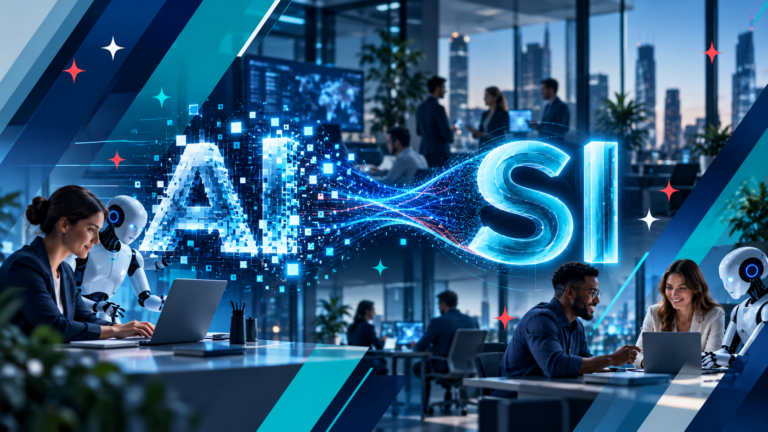
AI is moving fast. Really fast. One minute people are using it for any imaginable work task, and the next minute companies are trying to rebuild entire workflows and automations using AI. Businesses are now looking for people who can actually make AI work in the organization.
That’s where Enterprise AI Implementation Specialists come in. Professionals in this new and emerging role help companies turn AI into actual business value.
This blog discusses what Enterprise AI Implementation Specialists actually do, why companies need them, and why universities, colleges, and training centers should reskill people to this new in-demand job.
What Do Enterprise AI Implementation Specialists Do?
Enterprise AI Implementation Specialists integrate AI into business operations within a specific company. Their role sits between technology and business – understanding how AI can improve workflows, save time and money, automate human tasks, and support decision-making. More than anything, they are change agents – implementing innovation in often-conservative enterprise environments. Their goal is simple: make AI useful, usable, and impactful in the business.
At a typical company, employees spend hours every day manually summarizing customer calls, writing reports, or answering repetitive support questions. An Enterprise AI Implementation Specialist can introduce AI tools that automate these processes, train teams on how to use them, and redesign workflows around AI capabilities. The goal is not replacing everyone with robots overnight – despite what sci-fi movies promised us years ago – but helping organizations work smarter and faster with AI.
When AI first became widespread a few years ago, most companies were simply experimenting with a few tools. Someone would open ChatGPT, generate some content, test an AI image generator, maybe automate a small task, and that was enough to feel innovative. But now the conversation is shifting. Companies are asking “How do we actually integrate AI into the business in a scalable, secure, and useful way?”
And the timing is no coincidence. According to the World Economic Forum, AI and automation are expected to displace 92 million jobs while creating 170 million new ones. Enterprise AI Implementation is one of the new career paths emerging from this shift, as companies increasingly look for professionals who can help them adapt to the AI era.
Companies are Looking for AI Implementation Skills
Organizations are increasingly expecting employees to know how to work with AI tools, automate tasks, analyze information faster, and adapt to new workflows. But the challenge is much bigger than simply “using AI.” Many companies still don’t know how to actually implement AI across their organization in a practical, scalable, and useful way.
Some companies experiment with a few AI tools, but struggle to build AI workflows. Others don’t know which processes should be automated, which AI tools fit their needs, how to connect AI into existing operations, or how to make employees actually adopt these new technologies. In many cases, AI initiatives stay stuck at the “cool demo” stage without creating meaningful operational impact.
And from the employee’s side, the shift can feel overwhelming. Someone might be excellent at data analysis, operations, marketing, customer support, or project management, but suddenly the way that work gets done is changing, and workflows are increasingly powered by AI. For many employees, it can feel like the ground is shifting beneath their feet.
That is why Enterprise AI Implementation Specialists are valuable. Companies need people who can bridge business potential and AI capabilities – professionals who understand internal workflows, identify opportunities, implement AI solutions, and initiate business transformation using AI tools.
Universities, Colleges, and Training Centers Can Play a Part in The AI Era
The need for AI Implementation Specialists is affecting companies and education providers alike. As companies begin integrating AI into business operations, they increasingly need professionals who can lead implementation efforts inside the organization.
This creates demand for a new type of career-oriented training program. Education institutions can offer practical programs designed specifically for the Enterprise AI Implementation role. These programs should prepare professionals to identify AI opportunities inside organizations, redesign workflows, implement AI solutions, support adoption across teams, and help businesses integrate AI in a scalable and responsible way.
The target audience for these programs is broad. Some learners may come from business, operations, project management, or data-related backgrounds and want to transition into an AI-focused career path. Others may come from the technology units, or from completely different professional backgrounds with no prior tech experience at all, but are looking to reskill into a new role emerging in the AI era. In other cases, companies may send existing employees to reskill into internal AI implementation roles as part of their AI transformation strategy.
For universities, colleges, and training centers, this represents an opportunity to launch a new career-oriented program that reskills people to become Enterprise AI Implementation Specialists.
Preparing Students for the AI Era with Wawiwa Tech
Wawiwa supports universities, colleges and training centers across the U.S. – and around the world – with education solutions built for the AI era. As a global tech education provider, Wawiwa offers AI-proof reskilling programs and upskilling courses designed to match industry trends and employer needs.
Wawiwa’s Enterprise AI Implementation Specialist Program – a 4-month, 200-hour training program is designed to prepare students for one of the emerging career roles of the AI era. No previous experience is required, yet the program focuses on the exact type of practical experience employers look for when hiring candidates.
The program trains students to translate business needs into practical AI solutions, lead AI adoption processes, and design and optimize AI workflows that create organizational impact. Students learn how to identify opportunities for AI inside companies, deploy solutions, and continuously improve AI systems in business environments.
As part of the final project, students build a complete enterprise AI implementation plan – from diagnosing organizational needs and identifying high-impact opportunities to designing the solution architecture and implementation roadmap. Students also develop a working prototype, such as an automation, AI assistant, or agentic workflow, while defining governance, security, and operational considerations.
The project concludes with an executive-level presentation and live demo, where students present their solution, explain the expected business impact, and showcase a clear ROI model with measurable success KPIs. This type of hands-on experience is exactly what employers increasingly care about when recruiting talent.