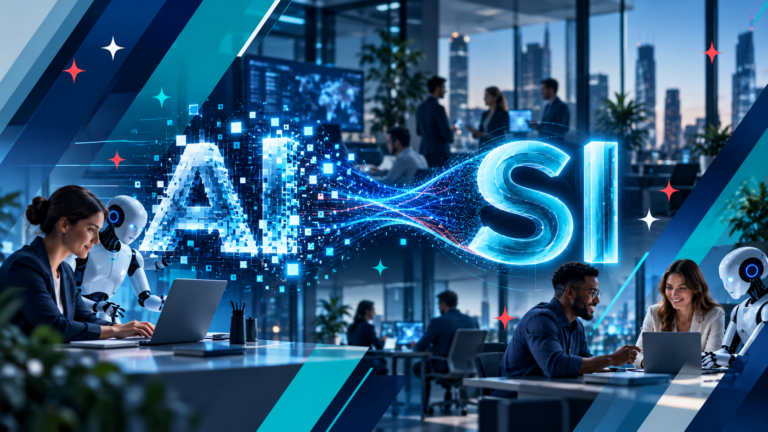
The dominant narrative has been clear: AI is replacing entry-level jobs. Companies rushed to automate workflows, streamline teams, and “do more with less.” But one tech giant just disrupted that storyline.
After integrating AI across operations, IBM reached an unexpected conclusion – the technology has limits. And instead of cutting junior roles, it’s tripling entry-level hiring, particularly among Gen Z talent.
What changed? What did IBM discover about AI adoption that others may be overlooking?
This blog discusses what IBM learned about the limits of AI, why human talent is becoming even more strategic in the AI era, and what this shift means for the future of entry-level careers.
What IBM Learned About the Limits of AI
AI delivers massive value. Almost 80% of organizations now use AI in at least one business function. It automates repetitive tasks, accelerates coding, enhances customer service, analyzes massive data sets in seconds, and increases productivity across departments. For enterprise companies, AI has become a powerful efficiency engine, reducing costs and speeding up execution in ways that were unimaginable just a few years ago.
IBM embraced this shift early and at scale. As a global leader in enterprise technology and AI solutions, it integrated AI into internal workflows and client-facing systems, testing firsthand how far automation could go. The results were impressive in structured, rule-based environments where tasks were predictable and data was clean.
But the deeper AI moved into complex, collaborative, and decision-heavy workflows, the clearer its limits became. AI struggled with ambiguity, context, cross-functional judgment, and the kind of adaptive thinking that entry-level employees develop through real-world experience.
Why Human Talent is Strategic in the AI Era
At first glance, the big narrative around AI has been layoffs, automation, and shrinking entry-level opportunities. Headlines and reports warned that digital tools could automate whole swaths of junior tasks and that Gen Z and early-career workers might find fewer doors open than previous generations. Many companies paused or reduced hiring as they invested in new technology, anticipating that machines would shoulder much of the work.
But here’s the plot twist: even with AI reshaping jobs, IBM announced plans to triple its entry-level hiring, defying the broader trend of shrinking opportunities for new talent. The Chief Human Resources Officer at IBM, Nickle LaMoreaux, explained that firms that double down on early-career hiring now will be the ones that succeed in the next three to five years.
IBM isn’t ignoring AI. Far from it. The company acknowledges that many traditional junior roles can be automated or augmented by technology, so it has rewritten job descriptions to focus on genuinely human strengths: customer interaction, creative problem-solving, contextual judgment, and collaboration. These are precisely the areas where AI falls short, and where entry-level workers can grow into strategic roles.
AI enhances productivity but does not replace the need for people who can think critically, communicate effectively, and adapt in real time.
AI increases efficiency. Humans create leverage. And in an AI-driven enterprise, the people who understand how to work with AI become indispensable.
And here’s the bigger question: what happens if companies stop hiring junior talent altogether? If organizations don’t train early-career professionals to understand AI systems today, who will manage, question, and improve them in a few years? Do we really expect to start teaching people how to work with far more advanced AI five or ten years from now – when the technology is exponentially more complex? Building AI capability starts with hiring and developing the next generation.
And beyond immediate productivity gains, there’s a long-term workforce reality companies cannot ignore: today’s juniors are tomorrow’s seniors. Without consistent entry-level hiring, organizations break their own talent pipeline. Human capital development and succession planning depend on nurturing early-career professionals who grow into technical leads, managers, architects, and decision-makers. If companies pause junior hiring for too long, they risk facing a leadership vacuum in a few years, with no experienced internal talent ready to step up.
What this Shift Means for the Future of Entry-Level Careers
The future of entry-level work is transforming. Traditional junior roles built around repetitive execution are being automated. But new entry-level positions are emerging that require something different: the ability to collaborate with AI tools, interpret outputs, question results, and apply human judgment. The baseline expectation is shifting from “can you perform the task?” to “can you work intelligently with technology to elevate the task?”
This means early-career professionals will need a hybrid skill set from day one. Technical fluency, data literacy, and AI familiarity will sit alongside soft skills like critical thinking, communication, adaptability, and problem-solving. Entry-level employees will be AI reviewers and decision-support contributors.
For companies, this shift reframes junior hiring as a long-term investment rather than a cost center. Organizations that continue building early-career pipelines will develop internal talent that evolves with AI systems instead of scrambling to retrofit skills later. Entry-level careers are the foundation of sustainable innovation.
Wawiwa Tech in the Spotlight
Wawiwa is a global tech education provider, offering AI-proof reskilling programs and upskilling courses tailored to the latest industry trends.
Our perspective is simple: AI is reshaping what professionals must know. That’s why we’ve adjusted all of our programs to fully integrate AI into the learning journey. For example, we transformed our Full-Stack Developer program into the AI Full-Stack Developer Program, where students work with AI throughout the entire process – generating code, debugging, refactoring, testing, and exploring different technical paths. Instead of focusing only on syntax, learners develop architecture thinking, system design skills, quality control, and decision-making – the human capabilities that remain critical.
In our Vibe Coding upskilling course, learners build applications by collaborating with AI – without manually writing code themselves. For many experienced engineers, that might trigger a “Wait… what?” reaction, and that’s understandable. But this is already the reality. By clearly defining problems, setting constraints, and guiding AI through the right decisions, learners can create functional applications without writing a single line of code.
In Wawiwa’s Product Entrepreneurship Sprint, participants go from idea to a working Minimum Viable Product (MVP) using Vibe Coding. They learn how startups are built – identifying problems, understanding users, validating ideas, shaping product strategy – and then use AI and no-code tools to turn those ideas into functional digital products. It reflects the same shift happening across industries: AI builds, humans decide, design, and drive.
Beyond technical skills, we emphasize soft skills that employers consistently demand, such as communication, teamwork, adaptability, problem-solving, and critical thinking. In the AI era, these skills are differentiators.