
Everyone’s talking about the global skills gap and tech skills shortage — the lack of skilled professionals to fill tech jobs. Covid-19 and the shift to remote and online business have widened that gap even further. Closing this gap can perhaps minimize the adverse effects of the pandemic.
A quick glance at the numbers reveals that the most pressing shortage lies in the realm of cyber security. According to Deloitte, “a massive and growing talent shortfall is one of the most critical challenges facing the cybersecurity world today.”
A recent study released by (ISC)2 claims that the cybersecurity talent gap currently translates to 4,000,000 unfilled cyber jobs, an increase of one million new vacancies from just one year ago. The world desperately needs more trained cybersecurity professionals.
The Good Guys, AKA the “White Hats”
One such high demand cybersecurity role is a Security Operation Center (SOC) Analyst. This highly lucrative and critically important job pits white hat cybersecurity professionals against hackers looking to penetrate an organization’s network for malicious purposes.
The SOC team does the important work of monitoring and combating threats to an organization’s IT infrastructure while assessing vulnerabilities and taking proactive action for security. They are skilled at working with the Linux environment and managing network system security and network infrastructures.
The problem is that there aren’t enough of them.
Hackers are well-aware of this fact. They’re exploiting new vulnerabilities as employees spend more time online while working from home from Covid-19. Cyber attacks are on the rise everywhere you look.
Tech Training to the Rescue
Unfortunately, college and university degrees won’t help us close the cyber skills gap anytime soon. The conventional pedagogical model takes too long to complete, while hackers don’t need four years of education to wreak havoc. What’s more, the know-how that academic institutions offer is oftentimes irrelevant by graduation, and academic degrees don’t focus on the practical skills needed to land entry-level cybersecurity jobs.
Our best hope to combat this worrisome phenomenon is cybersecurity training, reskilling, upskilling, and vocational education. There’s a real need to train as many individuals as possible to cybersecurity professions in high-demand.
The benefits are clear to all. More cyber jobs will be filled. People who lost their jobs to Covid-19 will get a chance for new employment and long-term job security. Additionally, a new generation of white hats will be reskilled to defend enterprises around the world against malicious hackers and their attacks.
Cybersecurity Tech Training and How it’s Done
Wawiwa Tech Training is an Israeli education provider that works with local partners across the globe to establish tech training programs or open new tech programs at their existing centers. These programs take professionals — with or without previous tech experience — and train them for success in specific tech jobs, like cybersecurity specialists.
Wawiwa offers two distinct programs for cybersecurity: an entry-level program for beginners, and an advanced program for upskilling. Wawiwa programs are delivered live, face to face or online in synchronous learning, by trainers and mentors with industry experience in cybersecurity.
The entry-level program requires no previous tech skills and is geared towards preparing graduates for cybersecurity analyst and SOC team member positions. The program is comprised of 450 hours of training and takes 9 months to complete. Graduates develop knowledge of cybersecurity tools, emerging threats, typical vulnerabilities and hacker behavioral patterns. Skills like system monitoring and operations, incident response and cyber forensics are acquired through real-world cybersecurity scenarios and hands-on interactive simulations.
The program relies heavily on simulations of real-life cyber attacks using Cyberium Arena, a proprietary advanced simulator, purpose-built for cyber training. This same simulator is used by militaries and enterprises around the world to educate the world’s next generation of cyber professionals. It allows trainers to demonstrate real-life cyber attacks, while students experiment with potential responses in real-time.
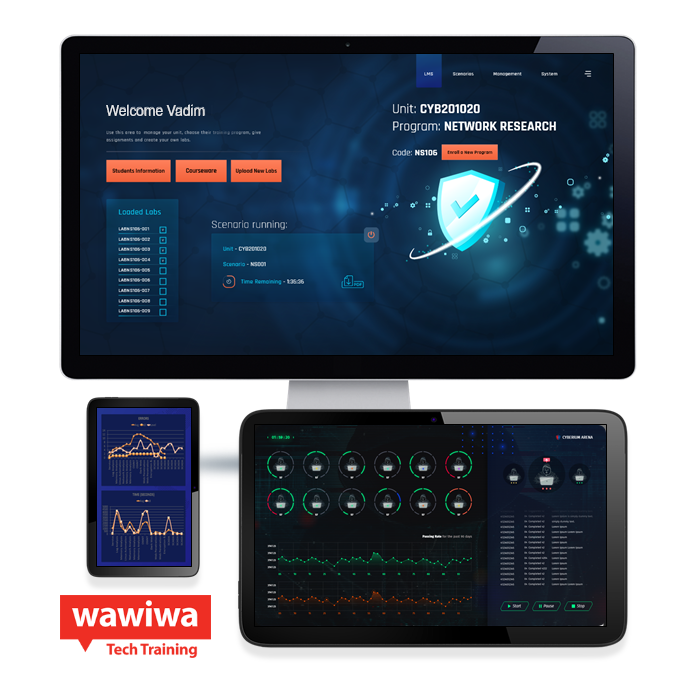
Students are challenged to identify attacks at their earliest stages and prevent significant damage to the organization’s network.
Dashboards and detailed reports provide the trainer and students a complete analysis of both performance and learning. Students use these analytics to celebrate their successes and learn from their failures, both on an individual and a team level.
The second, more advanced cybersecurity program – Cyber Security Investigator – is aimed at those professionals with prior experience in computer science, network management, or cyber who wish to upskill to cyber security or to catch up on the latest cyber threats, skills, tools, and technologies.
Specifically, the program prepares graduates for jobs in professions like Cyber Security Managers, IT Security Managers, SOC Managers and Cyber Forensics Investigation Managers.
Throughout the program, students develop a thorough understanding and familiarity with the more advanced aspects of cyber security. Students undergo in-depth specialization in a variety of cyber security disciplines, including cyber warfare, network monitoring, and identification of real-time hacking attempts.
Similar to the entry-level program, the advanced program is centered around developing the practical skills needed to succeed in the current job requirements in the market and takes a hands-on training approach through the use of the Cyberium Arena simulator. The simulator enables students to train on real-life cyber attacks, challenging them to think on their feet and draw on their training to devise strategies and tactics to counter the threat.