Skilling the World for AI

Infographic: Bridging the Tech Skills Gap in Europe and the Power of Reskilling

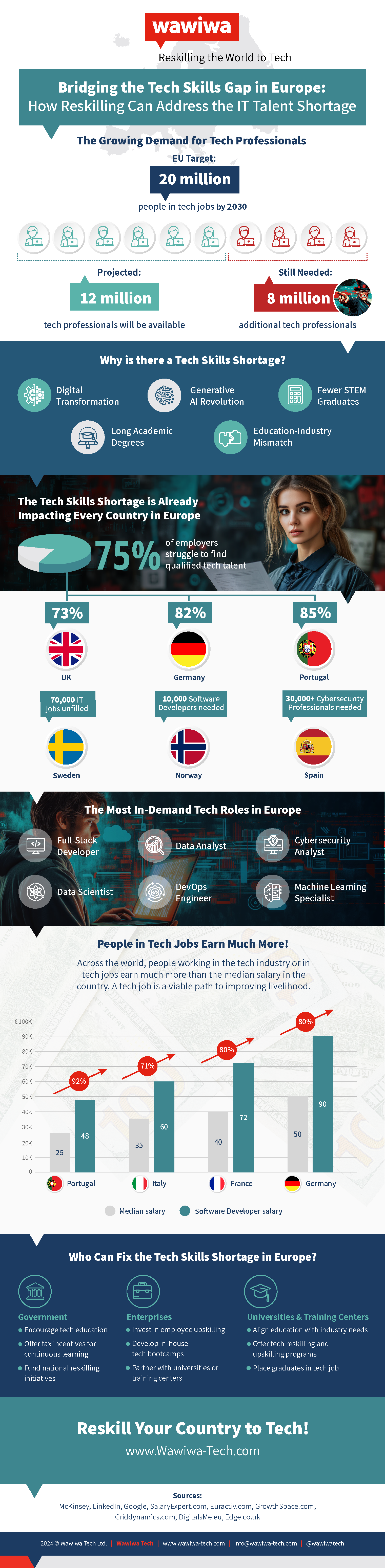
The European Union has set an ambitious target of having 20 million people employed in tech jobs by 2030. However, projections reveal a significant shortfall, with only 12 million professionals expected to be available, leaving a gap of 8 million skilled workers. Factors such as the rapid pace of digital transformation, the AI revolution, and mismatched education-to-industry pathways are driving this shortage. Employers are already feeling the impact, with 75% reporting difficulties in finding qualified tech talent. This issue spans across countries, with the UK, Germany, Portugal, and Spain among those most affected.

In-demand tech roles include Full-Stack Developers, Data Analysts, Cybersecurity Analysts, and Machine Learning Specialists, among others. These positions offer substantial earning potential, with tech professionals consistently earning more than the median salary in their respective countries.

Addressing the skills gap requires collaborative efforts from governments, enterprises, and educational institutions. Governments can encourage tech education and provide incentives for continuous learning, while enterprises should invest in employee upskilling or reskilling. Universities and training centers play a big role by aligning education with industry needs and preparing graduates for tech jobs. Together, these stakeholders can bridge the gap and reskill the workforce to meet Europe’s growing demand for tech professionals.

We’ve created an infographic highlighting the key insights on Europe’s tech skills shortage and the solutions to address it. You can download the infographic as a PDF by filling out your details below.

Get the Infographic as a PDF file...

Partner with Wawiwa to offer AI programs at your educational institution

Wawiwa is a global education provider focused on skilling the world for AI. Through partnerships with colleges, universities, and training centers in the U.S. and around the world, Wawiwa helps educational institutions launch local AI reskilling programs and upskilling courses quickly and effectively. Our proven JET Design™ (Job-Effective Training) methodology sets us apart. All programs are live (face to face or online) and instructor-led, with a heavy emphasis on hands-on practice, real-life projects, and industry alignment. Combined with always-up-to-date curricula, robust learning technology platforms, and education business know-how, Wawiwa’s approach delivers measurable results: quick launch of workforce-aligned programs and courses that result in employability, productivity, and AI adoption.

europe, Learning, reskilling, upskilling

Share post

Recent posts

Pathway to an AI-Literate Workforce
AI Workforce Transformation

From First Prompt to Everyday Impact: A Practical Pathway to an AI‑Literate Workforce

Your employees are already using AI. The question is: do they actually know what they’re doing? Companies are investing heavily in AI tools, yet many employees are still guessing what to prompt, what to trust, and what not to share. That gap can mean wasted investment and inconsistent results. The companies that win with AI will be the ones with an AI-literate workforce. This blog discusses how to get there – what to teach, when to teach it, and how to turn AI learning into productivity, safer practices, and better decisions.

Read More »
Companies Can't Protect Employees and Jobs from AI
AI Workforce Transformation

Companies Can’t Protect Employees and Jobs from AI

What happens when AI can do your job faster, cheaper, and around the clock? Companies are already adopting AI to automate tasks, cut costs, and rethink the human talent they need. Courts and policymakers are asking how far we should go to protect people and existing jobs from AI. But can we really preserve jobs exactly as they are while technology keeps advancing? This blog discusses why protecting people and jobs from AI is not a viable long-term strategy, why reskilling and upskilling are a shared responsibility, and what it will take to prepare the workforce for the AI era.

Read More »
Your College’s Degree Portfolio Needs an AI Update
AI Training

6 Signs Your College’s Academic Offering Needs an AI Update

AI is changing how people work across almost every profession, and colleges are starting to respond. In Florida, AI degrees grew from just 3 in 2022 to 30 in 2025 but is that enough for more than 1 million higher education students? Colleges need to move faster, with more short, practical AI courses aligned with employer needs. So, is your institution keeping up or falling behind? This blog explores six signs that it’s time for an AI update, what students need, and practical ways to bring AI into your degree portfolio.

Read More »