Can a machine read the entire internet, pass exams, write code, and still lack something your grandfather has?
AI can analyze huge amounts of data, generate answers in seconds, and sound impressively confident while doing it. Studies show it can reduce task completion time by up to 80%, turning work that once took hours into just minutes. That’s intelligence. But wisdom is something else. Wisdom comes from experience – from years of seeing what works, what fails, and when a decision that looks good on paper is actually a terrible idea.
Your grandfather might not know how to train a neural network… but he can walk into a room, listen to a conversation for two minutes, and know exactly who not to trust, and no dataset can teach that.
AI can process information. But it hasn’t lived a life.
This blog explores what AI still can’t do and why humans must keep learning in the age of AI.
How Businesses and People Use AI
AI is part of everyday life. People use it to write emails, generate ideas, summarize documents, and analyze data in the time it takes to drink a sip of your coffee. It can also do things that would have sounded like science fiction just a few years ago: generate realistic images and videos, write software code, translate conversations in real time, and even help doctors analyze medical scans.
Many professionals now turn to AI the same way they once turned to Google – as the first place they go when they need information, ideas, or help solving a problem.
Businesses are adopting it just as quickly. Quase 80% das organizações agora usam IA em pelo menos uma função de negócios. AI helps companies work faster, automate repetitive tasks, and uncover insights hidden in massive amounts of data.
In many ways, AI is becoming the ultimate productivity tool – a powerful assistant that helps people do more in less time. And its capabilities continue to evolve at an incredible pace.
But What Can’t AI Do?
Have you ever caught yourself thinking: “At this rate… what can’t AI do?”
Give it a prompt and it produces something that often looks impressively correct. But look a little closer, and some interesting cracks start to appear. AI can give you answers but it doesn’t know when the question itself is wrong, for now.
Ask it how to optimize a product that nobody actually wants, and it will happily produce charts, strategies, and roadmaps. A human with experience might pause and say, “Wait… should we even be building this?”
For now, AI can detect patterns but it doesn’t truly understand why people behave the way they do. It can analyze thousands of customer reviews, yet it may still miss the subtle emotional reason why customers love or hate something.
AI can generate incredibly convincing text but it can’t tell when something is technically correct but practically disastrous. Anyone who has followed GPS directions straight into a dead-end road knows the difference between having information and having judgment.
And perhaps most importantly, AI doesn’t truly understand what matters, at least yet. It doesn’t care about consequences, ethics, long-term impact, or the messy complexity of human life.
AI vs. Human Wisdom: Not the Same Thing
AI is incredibly intelligent. Some systems already perform at levels comparable to highly educated professionals. For example, ChatGPT scored around the top 10% of test-takers on the U.S. bar exam, a professional licensing exam for lawyers.
But passing an exam doesn’t mean understanding the world. Intelligence is about knowing things. Wisdom is about knowing what to do with them.
Imagine asking AI whether a company should launch a product. It can analyze market reports, summarize customer feedback, and produce a detailed strategy. But it doesn’t feel the uncertainty of risking millions of dollars. It doesn’t sense when the market mood is shifting. It doesn’t know when a decision that looks perfect in a spreadsheet could damage a brand or disappoint customers.
Humans develop that sense over time – through experience, mistakes, conversations, and consequences. It’s the kind of insight a seasoned manager, entrepreneur, or yes, even a grandfather might have when he simply says: “Something about this doesn’t feel right.”
AI can read the entire Ιnternet. But wisdom comes from living in the world.
And there’s another subtle illusion. Sometimes AI can feel surprisingly genuine as if it really understands you. You tell it about a difficult day at work, and it responds like a thoughtful colleague or even a psychologist. It says the right things, asks helpful questions, and seems empathetic. But behind all of that is still code.
AI doesn’t feel frustration, pressure, or disappointment. It hasn’t stayed awake worrying about a decision or experienced the consequences of being wrong. It’s extremely good at recognizing patterns in human language, including how empathy is expressed, but it doesn’t actually live those emotions.
That difference may be invisible in a conversation. But it’s exactly where intelligence ends and wisdom begins.
Wawiwa Tech: Why Human Instructors Matter
A Wawiwa é uma provedora global de educação tecnológica, que oferece Programas de requalificação à prova de IA e cursos de aperfeiçoamento profissional adaptados às últimas tendências do setor.
At Wawiwa, AI is integrated into the learning experience, helping students practice faster, explore ideas, and work with the same tools used in the tech industry. At the same time, we teach AI, equipping learners with the skills to understand, apply, and work alongside it in real-world roles, such as Desenvolvedor Full-Stack de IA, Analista de dados de IAe Gerente de produtos de IA.
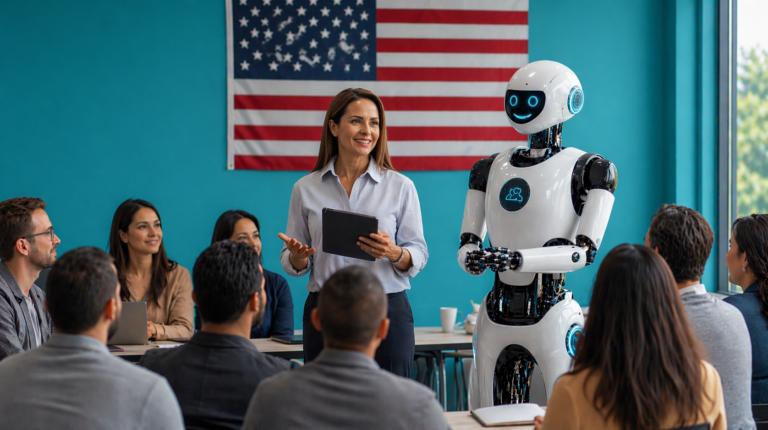
But this is exactly where many training programs get it wrong. Because while AI is powerful, it cannot replace human guidance.
That’s why a core component of Wawiwa’s Metodologia JET Design™ is its experienced trainers. These are industry professionals who bring knowledge and perspective. They’ve made decisions, faced challenges, worked in real environments, and understand the nuances that no tool can fully explain.
The result? Mais de 70% dos formandos da Wawiwa conseguem um emprego na área de tecnologia em até 2 meses após a formatura – because they learn tools and because they gain real-world skills, guidance, and confidence.
In a world where information is everywhere, what learners truly need is direction, judgment, and real-world insight.
And that’s something only humans can pass on, at least for now.